
Wauwatosa Directory Runs by Year
Wauwatosa city directory research works best as a shelf-by-shelf search. No single run is complete. The Wauwatosa Public Library Local History Collection gives the clearest list of printed volumes, while the Historical Society carries an older, overlapping group. Regional Milwaukee books matter too, since local addresses sometimes appear under a Milwaukee label.
| Directory collection | Years represented | Keeper | How to use it |
|---|---|---|---|
| Wright's Wauwatosa | 1926-1983, various years | Wauwatosa Public Library | Print or local-history access |
| Polk Wauwatosa | 1984-1994, with 1990 missing | Wauwatosa Public Library | Print comparison by name or address |
| Historical Society city directories | 1892-1989, not inclusive | Judith A. Simonsen Research Library | Appointment-only research |
| Wright and Polk Milwaukee | 1927-present, various series | Wauwatosa Public Library and regional libraries | Cross-check a Milwaukee postal label |
| Bresser's Milwaukee | 1988-2006 | Wauwatosa Public Library | Later address and business comparison |
| Historical-directory GIS layer | 42 directories, 1926-1992 | City of Wauwatosa GIS | Free mapped subset online |
Write down the publisher and exact year for every hit. "The directory" is not a sound citation when Wright, Polk, Bresser's, and regional Milwaukee volumes overlap. A missing entry may reflect a gap in the available run rather than a move. The absent 1990 Polk book is a known example.
Wauwatosa Directory Shelves and Help
The first in-person stop is the Adult Library at 7635 W North Avenue. Call 414-471-8484 before a focused visit to confirm that the needed Wauwatosa city directory year is available. The collection also joins directories with newspaper microfilm, online newspaper links, an obituary spreadsheet, and school yearbooks. Those companion sources help when two people share a name.
The Judith A. Simonsen Research Library is at the Kneeland-Walker House, 7406 Hillcrest Drive. Its office hours are Monday through Thursday, 9:00 a.m. to 1:00 p.m., and visits require an appointment. Call 414-774-8672 or email staff@wauwatosahistoricalsociety.org. Volunteers can use city directories with maps, archived newspapers, cemetery files, photographs, journals, and biographical folders. Some added research may require a fee or membership.
For records outside either local shelf, the Milwaukee County Historical Society town collection, UWM Archives, and Wisconsin Historical Society offer the next route. Each preserves material that predates the regular printed Wauwatosa run.
Map Wauwatosa Directory Addresses
The city's historical-directory GIS layer is an unusual bridge between paper and place. It holds a categorized subset drawn from 42 directories. Fields include the old house number, direction, street name, suffix, city, category, year, full printed address, and a matched current address. It is not a complete resident roll, so the original volume remains the source for a household entry.
The linked GIS source shows how the mapped historical directory data are exposed.
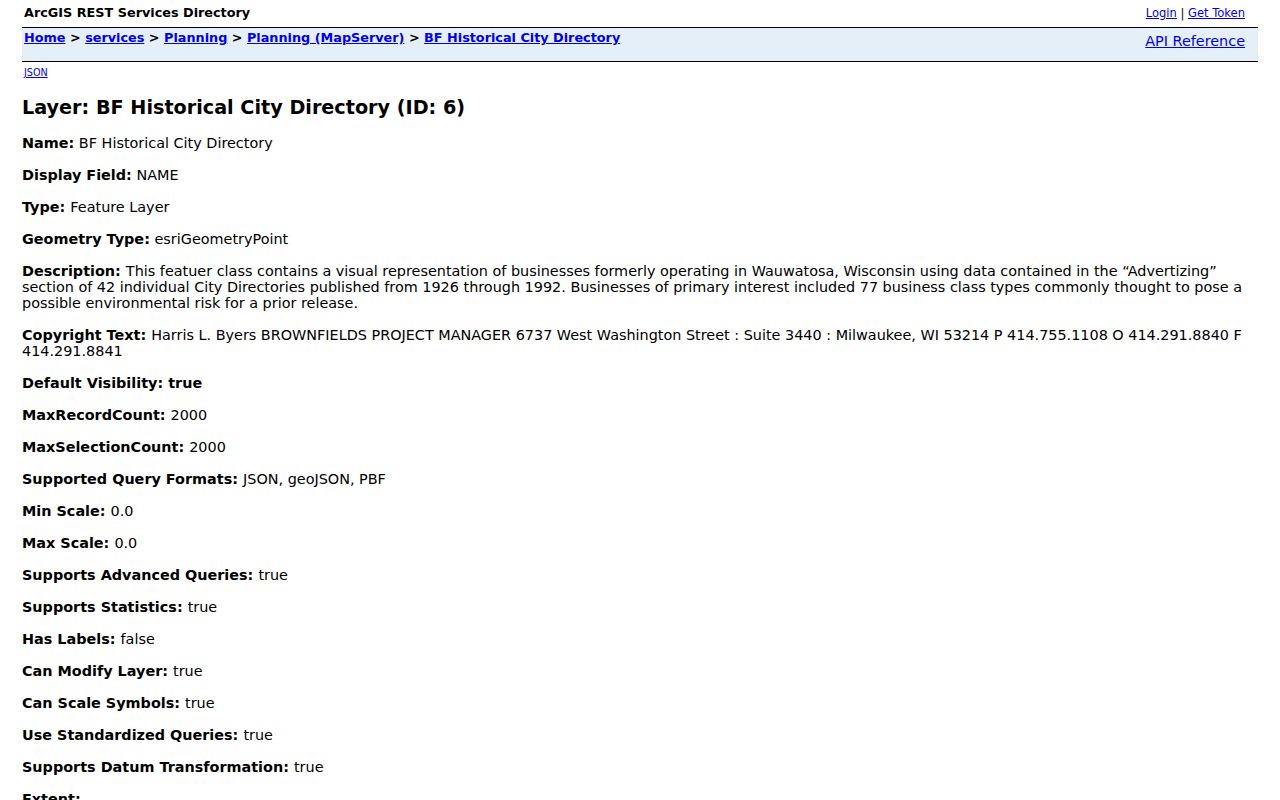
The current-address match is valuable when an old street form will not resolve in a modern parcel map. Confirm the match against the printed year and other address evidence before treating it as final.
| FULL_ADDRE | The address as represented for the historical directory record |
|---|---|
| MATCH_ADDR | The modern address bridge supplied by the mapped layer |
| Year | The directory year behind that mapped point |
| Category | The mapped record type, which also signals that the layer is selective |
Wauwatosa's 1932 Address Bridge
Wauwatosa renamed streets and changed house numbers in 1931. The 1932 directory is therefore more than another annual snapshot. Historical Society research identifies it as the key volume for new street names and number changes. When a 1930 newspaper or deed supplies an address that seems to have vanished, search the old printed form and then use the 1932 conversion evidence before trying the current map.
This quirk also explains why an exact current-address search can miss a real earlier household. Preserve every direction, initial, abbreviation, and old number in the notes. Then compare the GIS match field, the conversion book, and the original entry. A current parcel result alone cannot prove who occupied a house decades ago.
| 1931 | Citywide street renaming and renumbering changed address forms. |
|---|---|
| 1932 | The directory records new names and number changes as a practical bridge. |
| 1952 | Annexation changed the jurisdictional context for former Town of Wauwatosa addresses. |
Note: Search “Town of Wauwatosa,” Wauwatosa, Milwaukee, and both street forms before deciding that a directory record is absent.
Decode a Wauwatosa Directory Entry
The locally verified core fields are a surname or head-of-household name, street address, and occupation. The mapped layer adds structured address parts, year, category, and a current-address match. Other marks that often appear in old directories must be checked against the key printed in that exact volume. Spouse notation, employer fields, owner marks, widow labels, and page cross-references were not verified from a Wauwatosa page image and should not be assumed.
| Name | Use the printed spelling and initials; record variants in nearby years. |
|---|---|
| Address | Copy the house number and street exactly as printed. |
| Occupation | A locally verified field that can separate same-name residents. |
| Year and publisher | The citation needed to return to the same snapshot. |
| Volume key | The authority for any abbreviation or mark in that book. |
- Criss-cross directory
- A directory arranged by address or street instead of only by surname.
- Householder index
- An address-oriented listing used to find the named household associated with a place.
- Abbreviation key
- The volume's own list explaining shortened words and symbols. Consult it before interpreting a mark.
Confirm Wauwatosa Names in Print
A city directory offers a brief snapshot. Newspapers and obituaries add dates, kin, civic activity, and property events. Wauwatosa newspaper titles changed over time, so search by title and date range. Chronicling America covers Wauwatosa News from March 1900 through December 1922. Library-listed online coverage also includes Wauwatosa Now from August 2009 through August 2017 and West Now from August 2017 onward, while print and microfilm ranges differ.
The Wauwatosa Public Library obituary index records print date, full name, death date, place, age, cause, cemetery, and notes. Treat that row as a pointer. Retrieve the notice itself before using relationship or address details. At the Historical Society, bound Wauwatosa News volumes begin in 1900, and its early 1900-1917 index can be searched by a personal or corporate name.
Wauwatosa Yearbooks Resolve Names
Yearbooks provide a second local identity check when a Wauwatosa city directory lists only initials or a household head. Wauwatosa High School volumes cover 1924-1961. East runs from 1962-2019 with gaps, West from 1962 to the present with gaps, and the Oriole series covers 1928-1930. A class year, club, or photograph may distinguish two residents with the same name.
Use school material with care. It supports a time and school connection, not a present address. Compare the yearbook year with directory entries on both sides of it, then use a newspaper or obituary only when the identity details agree.
Trace Families Through Wauwatosa Directories
A strong family-history trail records what each source actually says. It does not treat silence as proof. Wauwatosa directory gaps, street changes, and the shift from Town to City labels make a careful sequence essential.
- Begin with a known name, address, and approximate year. Copy the printed spelling and full address.
- Check the nearest earlier and later available volumes, even if the years are not consecutive.
- Use an address or criss-cross section where available to inspect others listed at the place.
- Translate pre-1932 street forms before comparing the record with present-day GIS.
- Pair the directory snapshots with public census years. The 1950 census is the most recent generally available under the 72-year rule.
- Resolve conflicts through an obituary, cemetery record, probate docket, or naturalization index.
Disappearance can mean death, a move, an omitted year, or a person who was not listed. The Wauwatosa resident lookup describes how to verify a modern name without turning the historical shelf into a current-address claim.
Older Wauwatosa People Records
The Milwaukee County Historical Society preserves evidence from before the regular city directory era. Its Wauwatosa town collection spans 1840-1956 and includes tax rolls from 1856-1867, a mortgage book from 1850-1883, town-clerk records from 1865-1914, and a school census from 1845-1906. Poll lists survive for 1896, 1898, and 1902. Even dog-license material from 1865-1867 and 1879 can place a named person in town.
Naturalization declaration indexes cover Milwaukee County from 1836 through May 1941. Use the indexed name and declaration or volume/page reference to request the underlying record. UWM's Area Research Center supplies another path for pre-1907 vital and genealogy questions. These records answer different questions than a directory, so keep each citation separate.
When Wauwatosa Volumes Are Missing
Start with the library, then book an Historical Society appointment. Search the matching newspaper span and school yearbooks next. For an address near a boundary, examine the Milwaukee city series. Earlier town residents may surface in county tax rolls, school census records, polls, deeds, or naturalization indexes.
Maps can close a place gap without naming an occupant. Wauwatosa Sanborn fire-insurance coverage spans 1909-1951, and UWM has a digitized 1910 Milwaukee volume sheet showing local streets. The maps document footprints, use, construction, and street context. Pair them with a directory name rather than treating the map itself as a resident list.
Note: No official source reviewed identified a courthouse fire or citywide record loss, so never use one to explain a missing year.