
Wauwatosa Previous Resident Sources
The strongest house history uses records with different purposes. Tax and deed sources identify parcels and legal owners. Directories, census schedules, newspapers, and cemetery material restore the household layer. Their date ranges overlap unevenly, so the era determines the first stop.
| Source | Documented span | Custodian | House-history value |
|---|---|---|---|
| Milwaukee County deed index | Deeds from April 1, 1948; all recordings from 1962 | Register of Deeds | Grantor, grantee, instrument, and transfer |
| Wright and Polk directories | 1926-1994 local runs, with gaps | Wauwatosa Public Library | Names, addresses, and household clues |
| Historical-directory GIS | 42 directories, 1926-1992 | Wauwatosa Planning GIS | Old and matched current addresses |
| Town records | 1840-1956 collection | Milwaukee County Historical Society | Tax rolls, deeds, school census, poll lists |
| Permits and inspections | Varies by file | Wauwatosa Building Safety | Alterations and property events |
For a recent transfer, begin with the current parcel and deed index. For a mid-century household, use the directory nearest the event and compare a census year. Before the regular printed run, historical societies and UWM Archives become central. No result proves that nobody lived there.
Start a Wauwatosa Address Trail
Open the Wauwatosa assessor search or WAGEO and capture the taxkey, parcel number, legal description, situs address, current owner, and owner mailing address. Situs means the physical location. The mailing field tells where the tax bill goes and can differ.
Keep the legal description with every note. Street labels can change, while a subdivision, lot, block, and parcel lineage provide a steadier bridge. A different mailing address may suggest an owner lives elsewhere, but it does not identify the occupants.
Trace Milwaukee County Past Owners
The Milwaukee County Register of Deeds holds the recorded chain. Begin with the current grantee, the person receiving an interest, and work back to each grantor, the person conveying it. Tapestry offers paid online searching; mail, counter service, and historical appointments remain valid channels.
- Copy the owner's name, taxkey, and legal description from the city parcel record.
- Find that owner's acquisition deed and note its grantor, date, document number, and description.
- Search the grantor as an earlier grantee, using name variants and the same land description.
- Repeat until the online index reaches its cutoff.
- For earlier ownership, arrange the 24-hour historical appointment or seek deed-book and archival help.
- Grantor and grantee
- The grantor transfers an interest; the grantee receives it.
- Chain of title
- The linked sequence of recorded transfers for the same land.
- Legal description
- The lot, block, subdivision, or metes-and-bounds description that identifies land beyond its street label.
Wauwatosa Deeds Before the Web
Online coverage is precise: deeds are indexed and imaged from April 1, 1948 forward, while all recording types are indexed and imaged from 1962 forward. Earlier records did not vanish. They moved to office research, books, film, and historical collections. The Register of Deeds asks for a 24-hour appointment for historical ownership work.
City tax data reaches back to 2006, the county deed window reaches farther, and archival sources fill earlier gaps. A blank web result near a cutoff is a reason to change access channels, not an endpoint.
Note: Record exact spelling, date range, and legal description before contacting the office, since those details narrow an older search.
Wauwatosa's 1931 Address Change
Wauwatosa renamed and renumbered streets in 1931. The 1932 city directory and Milwaukee's 1930 address-conversion book bridge older and current forms. Searching only a modern house number can miss past residents on the same parcel.
The historical-directory GIS layer adds an unusual aid. FULL_ADDRE stores the directory address, while MATCH_ADDR records a current match. It covers a categorized set from 42 directories through 1992, not every resident, so confirm a match in the printed volume and parcel record.
Map Wauwatosa House Changes
Sanborn fire-insurance maps can date a footprint and show construction details in their covered years. UWM's digital collection includes a Wauwatosa-area sheet, while its house-history research sequence moves through assessor, tax, permits, deeds, maps, and archives.
For later alterations, Wauwatosa Building Safety and EnerGov can connect an address to permits or inspections. Online transactions may require an account and payment, and file coverage varies. Contact the department when a public screen does not expose an older record.
The UWM Libraries house-history page lays out the sequence used for Milwaukee-area property research.
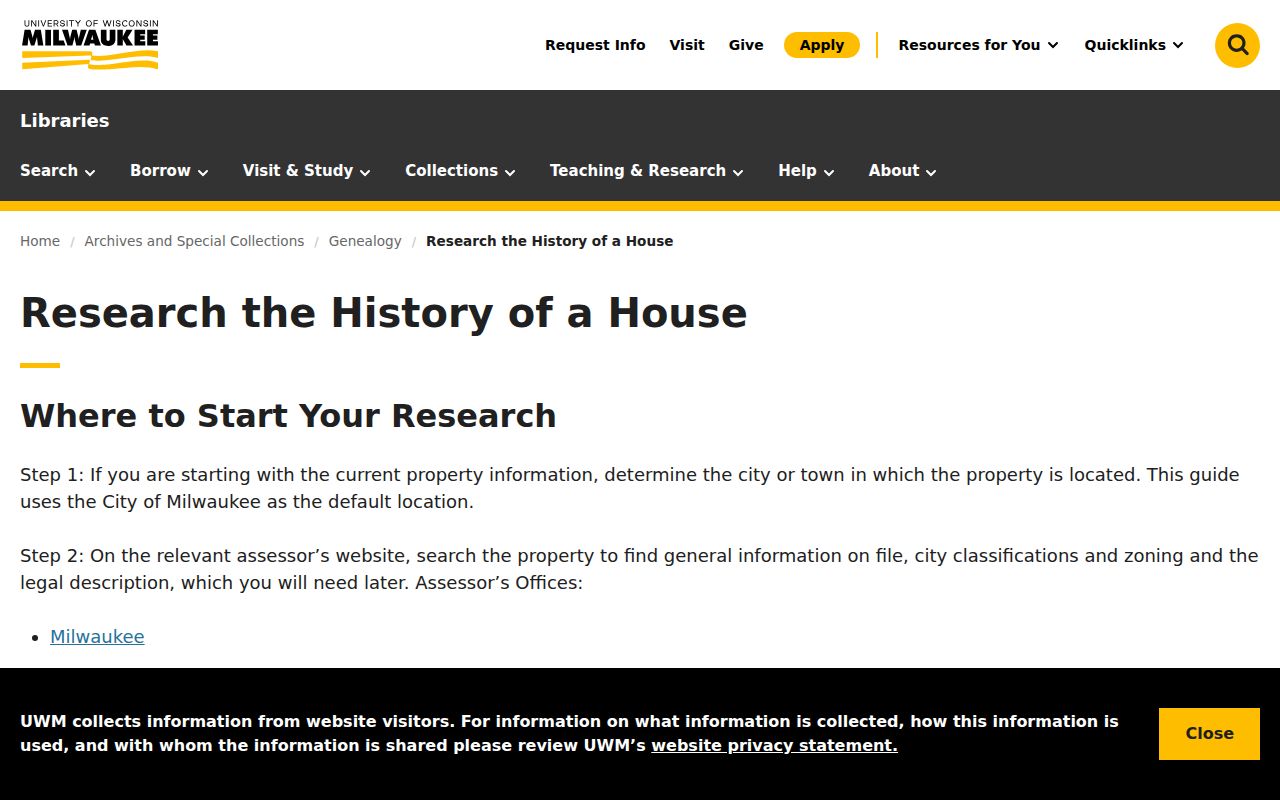
Its order reinforces the key distinction: a building timeline comes from several custodians, so assessor, tax, permit, deed, and archival findings should be compared rather than collapsed.
Early Wauwatosa Resident Clues
The Milwaukee County Historical Society's Town of Wauwatosa collection reaches beyond standard directories. It includes school census records from 1845-1906, tax rolls from 1856-1867, a mortgage book spanning 1850-1883, town-clerk records from 1865-1914, and surviving poll lists or registers for 1896, 1898, and 1902.
Even dog-license registers survive for 1865-1867 and 1879. Such a record can place a named person in the town before modern parcel portals existed, though it is never a full resident roll. Search the broader Town of Wauwatosa label as well as the city name, especially for land affected by the 1952 annexation.
Wauwatosa Archives Fill Gaps
Wauwatosa Public Library is the first local fallback for printed directories, newspaper microfilm, obituary material, and yearbooks. The Wauwatosa Historical Society adds maps, cemetery records, photographs, biographical files, and volunteer research by appointment. UWM's Area Research Center can help with Milwaukee birth indexing and pre-1907 vital or naturalization questions.
Ask a focused question. Give the old and current address forms, surname variants, a narrow date range, and the parcel description. That packet lets staff test a shelf, film run, manuscript, or index without treating an absent web hit as an absent person.
Photographs can support the place history, but captions need separate proof. The Historical Society's Lefeber collection contains more than 2,000 glass-plate negatives from about 1900-1935, and nearly 600 vintage postcards are searchable. Use a dated streetscape to compare a building, corner, or event, then confirm any named person through a directory, newspaper, or original archival description. Visual resemblance alone should never identify a resident.
Wauwatosa Deed Access Channels
The county deed trail is not limited to one paid portal. Tapestry searches Milwaukee County real-estate records by grantor, grantee, and document information, but an online index entry is not the same as a certified instrument. The Register of Deeds also accepts requests through its office and by mail. Those routes matter when an image is unavailable, a legal description is hard to read, or a copy must come from the custodian.
Historical ownership research before the online cutoff requires an appointment requested at least 24 hours ahead. Bring the current taxkey, legal description, known owner names, and a narrow date span. The broader online recording index begins in 1962, while deed images and indexes begin April 1, 1948. The two dates must not be blended. A mortgage, release, plat, or other instrument may follow the later all-recordings cutoff even when a deed falls within the earlier window.
When a name search produces several people with the same surname, follow the land. Compare the legal description, document number, recording date, and the grantor-grantee pair. A spouse, trust, estate, or changed name can interrupt a simple surname chain without breaking the parcel's actual title history.
Confirm Wauwatosa Previous Residents
A deed proves a recorded interest, not residence. Test each owner against the directory closest to the transfer year. Printed entries may provide occupation, spouse notation, and street address. Reverse-address material starts from the house rather than the name, which helps reveal people who were present but never held title. Compare adjacent directory years to avoid mistaking a one-year printing gap for a move.
Federal census schedules add household relationships at released census intervals. Pair them with directory years before and after the census, since the printed name may be only the head of household. Wauwatosa's 1952 annexation means an earlier family may be indexed under the Town of Wauwatosa or Milwaukee even though the present parcel is within the city. Try all three locality labels and both address forms.
Obituaries, cemetery records, and probate often explain the end of a trail. The Wauwatosa Public Library obituary index may record print date, death date, age, place, cause, cemetery, and notes. Milwaukee County probate reaches into the 1830s, with public-counter and copy procedures plus appointments for closed files. An obituary can identify relatives and a probate file can connect an estate to the next deed, but each claim still needs confirmation in the underlying record.
Wauwatosa Past Household Records
Owners are only part of the story. A criss-cross directory is arranged by address rather than surname, making it useful for finding who lived here before. Wauwatosa Public Library holds Wright and Polk runs, newspapers, an obituary index, and yearbooks. Collection detail belongs with the Wauwatosa city directories; the address trail uses one volume at a time.
- Choose the directory closest to a census year and check old and new address forms.
- Record each name, spouse notation, occupation, and address mark exactly.
- Find the household in the nearest released census and compare ages and relationships.
- Move through adjacent directory years to bracket arrivals and departures.
- Use newspapers, obituaries, probate, and cemetery files to explain a gap.
The WPL obituary index may include print date, death date, age, place, cause, cemetery, and notes. Milwaukee County probate reaches back to the 1830s, with counter, copy, and appointment routes for closed files. The Poor Farm Cemetery register, 1882-1974, can resolve names tied to the former County Grounds.
Lawful use. Research previous residents for house history, genealogy, heirs, or personal curiosity. Never use an address trail to follow, harass, or harm a living person.